Conveyor support structures & crossovers.
A conveyor is only as good as the steel holding it up and the way people get around it. Two related jobs — the structure that carries a line, and the bridge that lets a worker cross it — both come down to load, deflection, guarding, and installing over an operation that can't stop for long.
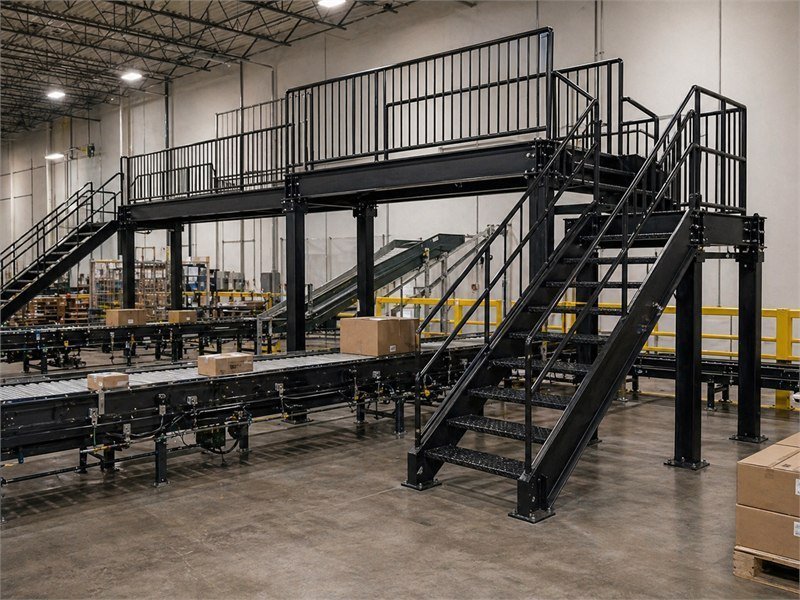
Short answer: a conveyor support structure carries the line's dead and material load while holding deflection tight enough that the belt tracks true; a crossover is an engineered stair-landing-stair bridge that lets workers cross a conveyor safely. Both are built to OBC and OHSA, and both are usually installed over a running line with only a short stop for the lift.
The support structure: deflection usually governs
People assume strength is the design driver on a conveyor support. Often it isn't — deflection is. A support that's strong enough but flexes under load lets the conveyor sag, and a sagging conveyor mistracks, spills, and wears its belt. So the steel gets sized to a tight deflection limit, not just to carry the load, and the connections are detailed to stay rigid. Alongside it runs an access catwalk so the line can be serviced without a lift every time.
The access alongside
An elevated conveyor needs a way to be reached — jams cleared, belts adjusted, rollers changed. That's a catwalk to the standard access spec: roughly 4.8 kPa (100 psf) live load, a 1070 mm (42") guard with mid-rail and toe board (OBC §3.3.1.18, OHSA Reg. 851), and bar-grate decking that sheds debris and lets sprinkler coverage through. See conveyor support platforms for the full picture.
The crossover: don't make people climb the line
Where a conveyor blocks a walking route, workers will cross it — over or under — unless you give them a safe way across. That's a crossover: stairs up one side, a landing over the belt, stairs down the other, all guarded, sized to clear the conveyor and its load. It's a small structure that removes a real injury risk, and it's engineered to the same OBC stair and guard rules as any other stair.
Installing over a live line
The hard part is rarely the steel — it's putting it in without shutting the operation down. The structure and guarding are designed so the bulk of the work happens off to the side, and the pieces are staged to drop into place during a short, planned window. On an Oakville project we set two crossover bridges over a live conveyor with the line down only for the lifts themselves. That sequencing is as much a part of the design as the connections.