Roof access: stairs vs. ladders.
There's a rooftop unit that needs servicing, and someone has to get up there safely with tools. Stair, ship's ladder, or a caged ladder to a hatch? The right answer is set by how often the roof is used and what the code requires — not by whatever's cheapest to bolt on.
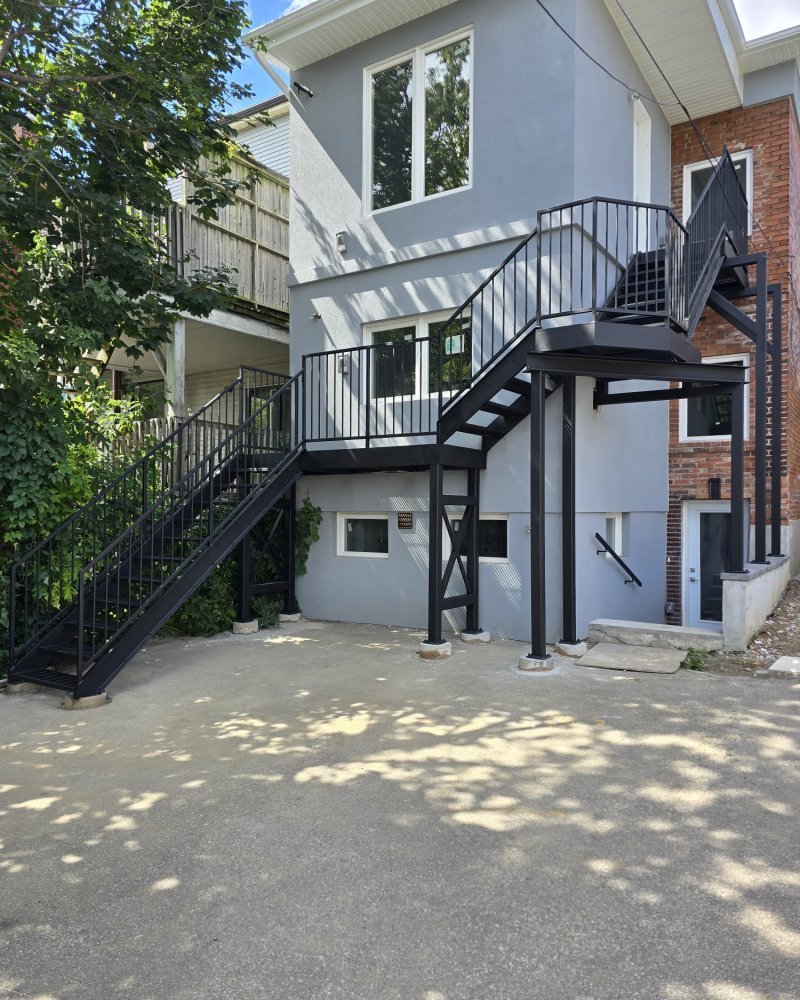
Short answer: use a stair for roofs accessed regularly or with tools; a ship's ladder when a stair won't fit but access is still frequent; and a caged fixed ladder to a hatch for tight, infrequent, single-worker access. All three are governed by the Ontario Building Code and OHSA — the choice among them is driven by access frequency and what's on the roof.
Start with the question that actually decides it
Not "what's cheapest" — how often does someone go up, and what are they carrying? A rooftop packaged unit on a quarterly service contract, a chiller that needs filter changes, or a green roof that gets walked weekly all imply routine access. Routine access with tools wants a stair. A single roof drain that gets checked once a season doesn't justify a full stair — a ladder to a hatch is proportionate.
The three options, in order of footprint
- Roof access stair (~30–38°) — easiest and safest to climb, handles tools and two-way traffic, but needs the most floor area and structure. The default when the roof is worked regularly. Can run interior to a penthouse/hatch or as an exterior tower.
- Ship's ladder (50–70°) — a steep-pitch stair that fits where a conventional stair won't. Still climbable facing out with a hand free; a good middle ground for frequent access in a tight space.
- Caged fixed ladder (75–90°) — vertical, smallest footprint, with fall protection. Best for infrequent, single-worker access to a roof hatch. Climbed hand-over-hand facing the ladder, so it's not for carrying much.
Don't forget the roof once you're up there
Getting onto the roof safely is only half of it — OHSA requires fall protection at the roof edge and around openings wherever workers go. The usual answer is a non-penetrating (ballasted) guardrail around the maintenance path and the equipment, which protects the worker without a single penetration through the membrane to void a warranty. We did exactly this on a London rooftop — 420 linear feet of ballasted guardrail, no membrane penetrations.
Interior or exterior?
Interior access (to a roof hatch or through a penthouse) keeps everything conditioned and out of the weather, but eats interior floor. Exterior access — a stair tower or ship's ladder up the outside — frees the floor and is common for maintenance-only roofs, with a galvanized finish for the exposure and an engineered wall connection. Neither is "better"; it depends on your building.
Frequently asked
Does rooftop equipment need a stair or is a ladder enough?
What's the difference between a roof access stair, a ship's ladder, and a cage ladder?
Do I need a guardrail around rooftop equipment?
Can the roof access go on the outside of the building?
- Roof access stairs — fabrication & install
- Ship's ladders — the steep-pitch option
- Cage ladders — vertical access to a hatch
- Guardrails & handrails — roof-edge fall protection